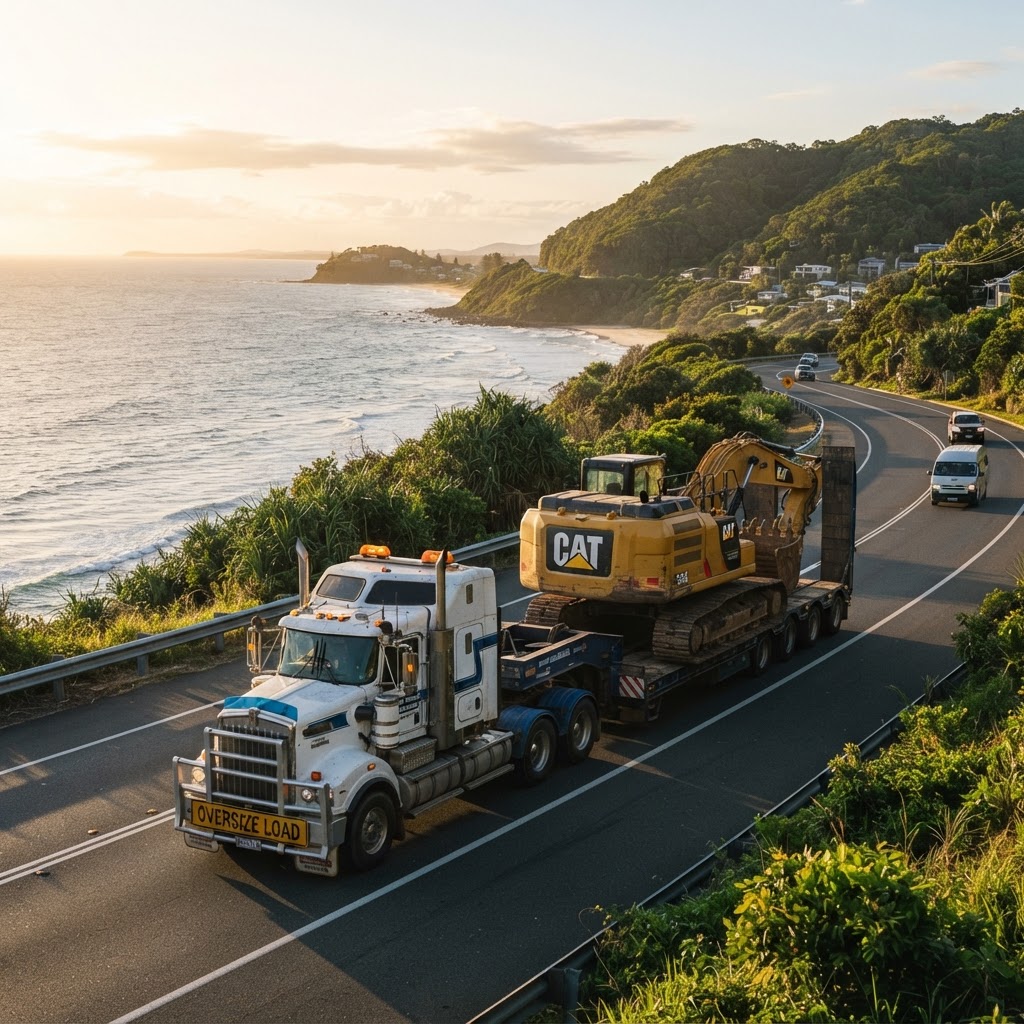
Low Loader Hire Sunshine Coast for Plant and Machinery
Low loaders are the workhorse of machinery transport — a low, flat deck that sits close to the ground so plant can be driven or winched on and off with minimal ramp angle. We coordinate low loader hire across the Sunshine Coast for everything from routine excavator shifts to oversized structural loads.
Why low loaders suit machinery transport
The defining feature of a low loader is its deck height. By dropping the load platform below the trailer wheels, the deck sits low enough that tracked and wheeled machinery can be loaded under its own power. This makes low loaders the go-to for excavators, dozers, rollers, graders and any plant that needs a gentle ramp angle to climb aboard.
Compared to a tilt tray, a low loader carries heavier and taller machinery safely and legally. Compared to a flat-top trailer, the low deck keeps taller loads within height limits — critical for oversize plant that would otherwise exceed the 4.3 metre general access height.
The low deck height also means the centre of gravity stays low, which improves stability during transport. This matters particularly for tall, narrow loads like piling rigs and drilling equipment that would be top-heavy on a higher deck.
Low loader types and what they suit
Not all low loaders are the same. The right configuration depends on the load dimensions, weight and site access. Here are the main types we arrange:
- Standard low loader — A fixed-deck low loader with ramps, ideal for routine machinery shifts — excavators, skid steers, small dozers and rollers up to around 40 tonnes.
- Drop deck (step deck) — A two-level deck that drops down behind the gooseneck, giving extra length for taller loads while keeping the deck low. Suited to machinery that is both long and tall.
- Extendable low loader — A deck that telescopes out to carry longer loads such as bridge beams, long steel or extended plant. Used when a standard deck is too short for the load length.
- Widening deck (jinker) — A deck that widens to carry loads beyond standard width. Paired with over-mass axles for heavy, wide consignments that need permit and pilot support.
- Gooseneck low loader — A detachable gooseneck allows the front of the trailer to drop to ground level, so very heavy plant can be driven straight on. Used for the largest earthmoving equipment.
- Multi-axle low loader — A low loader with more axles to spread the load weight, used for over-mass consignments that exceed standard axle group limits. Paired with permits and sometimes pilot vehicles.
Access tips for tight Sunshine Coast sites
Many Sunshine Coast work sites are in established industrial estates or coastal developments with limited room to manoeuvre. Kunda Park, Forest Glen and Yandina all have yards where overhead services, narrow gateways and tight turning circles affect which trailer can get in.
When requesting a low loader, it helps to tell us about site access — gate width, overhead clearance, turning space and ground condition. If a standard low loader cannot get in, a smaller trailer or a different loading arrangement can often solve the problem. For sites with no drive-on access, winching or crane loading can be arranged.
For residential sites, a tilt tray may be more practical than a low loader where access is tight. We assess the site and recommend the right equipment — the goal is to get the machine in and out without damage to the property or the plant.
What affects low loader hire rates
Low loader pricing is driven by a few key factors: the trailer type required, the load weight and dimensions, the distance and route, and any permits or pilots needed. A short local shift of a 20-tonne excavator between two Kunda Park yards is priced very differently to a 60-tonne over-mass move from the Coast to Toowoomba.
Other factors include whether the movement needs to happen at night or on a weekend, whether bridge or route restrictions apply, and whether the site requires a specific time window for loading or delivery. Providing accurate details up front means the quote reflects the real job.
QLD regulatory context for low loader loads
Most machinery moved on a low loader stays within standard dimension limits and does not require a permit. However, loads that exceed 2.5 metres in width, 4.3 metres in height, or 19 metres in length require an NHVR oversize permit. Wider loads — 3.5 metres and above — trigger pilot vehicle requirements.
Over-mass loads that exceed statutory axle weight limits require a separate over-mass permit, often with route-specific bridge assessments. The multi-axle low loader configuration is used to spread the weight and keep the load within legal axle group limits. We coordinate all permit applications as part of the service.
Process — from enquiry to delivery
When you request a low loader, we start with the machine details — type, operating weight, dimensions and condition. We then confirm the right trailer type, check site access at both ends, assess the route for any restrictions, and arrange permits or pilots where needed. Once the quote is accepted, the movement is scheduled and the load is transported by an experienced operator.
For routine local shifts, the whole process can happen within 24 to 48 hours. For oversize or over-mass loads requiring permits, allow 3 to 7 days. Call 0489 953 573 for urgent requests or submit a quote request online.
Ready to move? Get a heavy haulage quote today.
Get a Heavy Haulage Quote
Tell us about your load and we'll confirm the right equipment, route and pricing. The more detail you provide, the faster we can respond with an accurate quote.
Questions & Answers
What is the difference between a low loader and a tilt tray?
A low loader has a low fixed deck and is loaded via ramps, making it suitable for heavy and tall machinery. A tilt tray tilts the whole deck to slide loads on and off, and is better suited to lighter equipment, shipping containers and breakdown recovery.
How wide a load can a low loader carry?
Standard low loaders carry loads up to 2.5 metres wide under general access limits. Wider loads require a widening-deck trailer plus an oversize permit and, depending on the width, pilot vehicles. We arrange all of this as part of the job.
Do I need to organise loading ramps or is that included?
Low loaders come equipped with loading ramps. If your machinery cannot be driven on — for example, non-operational plant — winch loading or crane loading can be arranged. Let us know the machine condition when you request a quote.
Can a low loader get into tight industrial sites?
It depends on the site. Gate width, overhead clearance and turning room all matter. If access is tight, a smaller trailer or a different loading method may be needed. Describe your site access when requesting a quote and we will match the right equipment.
How is low loader hire priced?
Pricing is based on trailer type, load weight and dimensions, distance, and any permits or pilots required. Local Sunshine Coast shifts are typically charged by the hour or a flat rate, while longer movements are quoted as a full job.
Do you provide the driver and the trailer together?
Yes. Low loader hire is supplied as a fully serviced transport package — trailer, tow vehicle and an experienced operator. We do not hire bare trailers.
What is the maximum load height for a low loader?
Low loader deck height varies by trailer type, but the load platform typically sits around 600 to 900 millimetres off the ground. This keeps most machinery within the 4.3 metre general access height limit. Taller loads may need a drop-deck or extendable trailer to stay within limits.
Can a low loader carry two machines at once?
Depending on the deck length and the machine sizes, two smaller machines can sometimes be loaded on the same low loader. This is more cost-effective than two separate trips where the load fits. We confirm whether a dual load is possible when you provide the machine details.
Related Services
Heavy Haulage Sunshine Coast for Oversize and Heavy Loads
Sunshine Coast Heavy Haulage coordinates specialist heavy transport for plant, equipment and oversize loads across the Sunshine Coast, South East Queensland and beyond. From a single excavator shift between sites to multi-vehicle over-mass moves along the Bruce Highway, every job is planned, permitted and piloted to suit the load and the route.
Learn moreMachinery Transport Sunshine Coast for Construction Equipment
Moving machinery is what we do most. Whether it is a mini excavator heading to a residential site or a 70-tonne earthmover relocating between projects, we coordinate the right trailer, the right route and the right timing to get plant where it needs to be — safely and on schedule.
Learn moreTilt Tray Truck Hire Sunshine Coast
A tilt tray truck has a tray that tilts and slides back to ground level, allowing loads to be winched or driven on without separate ramps. Tilt trays are a versatile option for lighter equipment, shipping containers, site materials and breakdown recovery across the Sunshine Coast.
Learn moreGet a Heavy Haulage Quote
Tell us about your load and we'll confirm the right equipment, route and pricing. Permits and pilot vehicles arranged as part of the service.
24/7 dispatch · NHVR permit coordination · Pilot vehicles arranged